Reflective Practice for Continuous Growth as an Educator
Published date
Last modified date
Reading Time: 6minutes
“We don’t learn from experience, we learn from reflecting on experience” (John Dewey).
Reflective practice is the intentional process of examining your teaching experiences to learn and improve. It’s not about self-criticism or dwelling on mistakes—it’s about asking meaningful questions: What happened? Why did it happen? How did I and others feel in the moment? How do I feel about it now? What might I change for next time? This hub post describes the benefits of developing an intentional reflective teaching practice and offers some tried and true tools and models to help get you started. It also addresses what to do if you receive student feedback you find surprising or unfair.
Why is Reflective Practice Especially Important for Educators?
Teaching is dynamic and relational. Every class involves diverse learners, varied expectations, and ever-shifting external conditions which, though beyond your control, often have an impact on what transpires in the classroom. Reflection helps instructors adapt, innovate, and stay grounded in evidence-based strategies, but also to step back, get curious, and take stock of whether our actions and approaches are having the impact we hope they are. Sometimes even the best intentions might be misinterpreted by students, and the most skillfully planned lessons may take the learning to unexpected places. Research on expert teaching shows that mastery isn’t simply about years of experience—it’s about learning from experience and adjusting one’s practice accordingly.
For novice instructors, reflection can help build confidence and resilience and reveal which tools and strategies may be lacking. For seasoned educators, reflection can prevent stagnation, foster continuous improvement, and remind us that teaching is more than a job like any other, it’s a craft.
We may not feel inclined to reflect when things are going well (because hey, why focus on what’s not broken?), or when things go badly (because “ouch”— it’s painful to re-visit a difficult moment you just lived through!), but in both cases reflecting on what happened will benefit you and your students.
The Importance of Ongoing Reflection
Though there are moments in each semester, when many of us stop to reflect (e.g. after receiving “Early Course Check-in” results in Week 5, or a summary of the “Student Course Feedback” surveys after week 14), reflection is most powerful when embedded throughout the teaching cycle. Here are a few ideas to spark a regular reflective practice:
After each class: Take five minutes to jot down what worked well and what didn’t. (Your future self will thank you if you take some of these notes right on your lesson plan itself, so that when you teach the course next time you will see things like “this participatory activity needed 12 minutes instead of 7” or “students didn’t understand this example, find a more recent one”).
Conversations with fellow instructors: This can take many forms: it may look like a regular check-in with a more experienced faculty member in your department, or with a Teaching and Learning Consultant mentor if you’ve been assigned one. It may also be more of a casual one-off conversation with a friend who teaches at a different institution who is “down in the teaching trenches” too as they can offer “insider-outsider” perspectives on the classroom stories and strategies you share.
Developmental Observations of Teaching: Teaching can feel lonely, as we so rarely get to see other faculty in action or to be observed by peers. You are always welcome to reach out to Teaching and Learning and request for a Consultant to come in and conduct a Developmental Observation of teaching. You would then receive a full report with detailed examples of your strengths alongside suggestions for improvement and would be invited to participate in a follow-up debrief and coaching session.
Early Course Check in and Student Course Feedback Survey: More information and specific details about this new process at Conestoga can be found here.
Informal Feedback from Students: You need not wait for responses to roll in from the Week 5 Early Course Check-in or end of semester Student Course Feedback surveys. This hub post offers many ideas for how you can solicit feedback from students on an ongoing basis.
Continuous reflection can help you respond to challenges in real time and also creates a record of growth that can inform teaching portfolios and professional development plans.
Models for Reflection
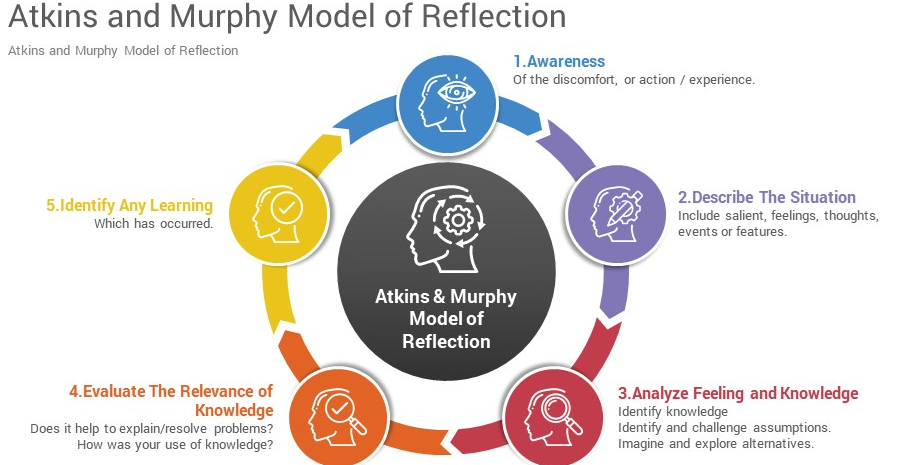
There are numerous models for reflection that faculty find helpful (See Boud et al., 1985; Gibbs, 1988), but Atkins and Murphy’s (1994) cyclical model is especially pragmatic as it encourages us to face head on the most uncomfortable situations we find ourselves in, to analyze from all angles the factors that contributed to the discomfort; and helps us imagine and explore alternatives that we can apply to future actions.
Reflecting on Feedback From Students
Most of the time, student evaluations of teaching offer a lot of valuable information for faculty. You may think, for example, that you consistently provide clear rubrics and assignment instructions, but if several students comment that they found these unclear compared to other courses, you may want to incorporate some new strategies to clarify expectations about assessments moving forward. You may also find yourself pleasantly surprised—students articulating things they felt you did effectively that you may not have even realized (e.g. perhaps several students comment on how much they appreciate the examples you give in class from your own industry experience, or how passionate a presenter you are). Research has shown that when constructive student feedback is paired with related professional development opportunities, it becomes especially meaningful and actionable (Röhl et al., 2025). At Conestoga, our Teaching and Learning Department is always here to offer these PD opportunities via our weekly workshops and microcredential courses and one-on-one consults.
Conestoga’s new Student Course Feedback survey has also been carefully designed to ensure that students have a space to reflect on the course itself that is separate from the feedback they provide to you as instructor. This helps ensure that you’ll be able to reflect on things within your control (clarity of instructions for assignments; pacing and passion when teaching etc.) above and beyond the restraints of the course you inherited (whether or not a final Multiple choice exam is appropriate; the fact that the textbook didn’t have accessible diagrams).
Problematic Student Feedback
Unfortunately, there is sometimes a small percentage of students who offer problematic and prejudiced direct commentary on faculty’s teaching abilities and this can be very hard to receive.
For example, Heffernan’s (2021) research identified increasing prevalence of abusive comments, heavily directed at women and marginalized faculty. Understandably, professors on the receiving end of this feedback experience these comments as stressful and anxiety-inducing. Marginalized educators may feel that evaluations are sometimes unfair—with databases showing racist, sexist, and homophobic biases in qualitative student feedback. Fortunately, as Drue & Bifulco (2025) research about Chairs’ Interpretations to Address Bias notes, department Chairs and program directors know that this can occur and that some students use the end of semester surveys as a way of “punishing” faculty based on prejudices they hold or because they were unhappy with grades they received in the course. Chairs often perceive Student Evaluations of Teaching as potentially biased when low scores appear targeted at women; faculty of color; and others from equity-deserving communities. As a safeguard, Chairs often choose to: 1) discard outlier evaluations, 2) examine response rate metrics, 3) consult with instructors to contextualize ratings, and 4) use triangulated evidence (peer reviews, teaching artifacts etc.) to get a better sense of an individual faculty member’s performance.
Studies by scholars like Khokhlova et al., (2023) and Mengel et al. (2019) remind us that instructors should interpret evaluations critically, contextualize results, take in feedback that merits reflection and can lead to growth, but to avoid equating scores with competence.
Moving Forward
Though we can’t control things like student biases or institutional constraints—there still is a lot that is within our control when teaching and so it’d be wise of us to spend most of our reflective energy on these things. Some examples include:
Clarifying expectations: Provide clear rubrics and assignment guidelines, and opportunities in class for students to familiarize themselves with rubric categories by looking at exemplars.
Enhancing engagement: Use a lesson planning template (like BOPPPS) that incorporates active learning techniques and allows for smooth transitions between direct instruction (i.e. “lecturing”) and interactive participatory strategies.
Improving feedback loops: Use weekly comprehension checks in class and regular “start, stop, continue” style surveys to catch issues early and make sure students are indeed learning what you’re working hard to teach them.
Building inclusivity: Diversify examples and materials to reflect student identities; share multiple examples from your own experiences or recent news stories to help students see why the topics you’re covering are relevant to their own lives, and solicit their opinions and ideas.
Taking time to reflect intentionally about your teaching, and focusing on actionable steps, will help you grow as an educator and likely feel more empowered and less overwhelmed semester to semester.
Boud, D., Keogh, R., & Walker, D. (1985). Promoting Reflection in Learning: A Model. Reflection: Turning Reflection into Learning. London: Routledge
Drue, C.R., Bifulco, C.A. (2015). Beyond the Numbers: How Directors and Chairs Interpret Student Feedback to Equitably Evaluate Teaching. J Acad Ethics23, 1499–1521. https://doi.org/10.1007/s10805-025-09611-5
Gibbs, G. (1988). Learning by doing: A guide to teaching and learning methods. Further Education Unit.
Heffernan, T. (2022). Sexism, racism, prejudice, and bias: A literature review and synthesis of research surrounding student evaluations of courses and teaching. Assessment & Evaluation in Higher Education, 47(1), 144-154. https://doi.org/10.1080/02602938.2021.1888075
Khokhlova, O., Lamba, N., & Kishore, S. (2023). Evaluating student evaluations: Evidence of gender bias against women in higher education. Frontiers in Education, 8, Article 1158132. https://doi.org/10.3389/feduc.2023.1158132
Mengel, F., Sauermann, J., & Zölitz, U. (2019). Gender bias in teaching evaluations. Journal of the European Economic Association, 17(2), 535–566. https://doi.org/10.1093/jeea/jvx057
Röhl, S., Bijlsma, H. & Schwichow, M. (2015). Can feedback from students to teachers improve different dimensions of teaching quality in primary and secondary education? A hierarchical meta-analysis. Educ Asse Eval Acc37, 35–71. https://doi.org/10.1007/s11092-024-09450-9
Share this Teaching Tip
Lauren Spring
Lauren Spring, PhD, has been a post-secondary educator since 2012. Before joining Conestoga as a Teaching and Learning Consultant, Lauren taught at Wilfrid Laurier, Brock, Ryerson, York, and the University of Toronto where she also completed her PhD in Adult Education and Community Development. She has also led workshops for students and faculty at colleges and universities across the country. Lauren holds an MA in International Development and has expertise in critical disability and mad studies, trauma work, research-based theatre, role-play simulations, and feminist and arts-based approaches to adult education and community engagement. Lauren has also worked as an educator at the Art Gallery of Ontario since 2008 where she designs and delivers art tours and workshops for elementary and high school students and diverse groups of adult learners.