Pam Hall Builds Interprofessional Communication Through Scenario-Based Learning
Published date
Last modified date
Reading Time: 5minutes
Pam Hall, BSc, RRT, FCSRT, is a graduate of the University of Western Ontario and Fanshawe College and has proudly been an RRT since 1996. After graduation, Pam was fortunate to begin her teaching career at Fanshawe College, and she joined the faculty team at Conestoga College in 2008. Pam has a passion for neonatal critical care, and she worked clinically in the NICU in London, Ontario for 20 years. In 2016, she was awarded Fellowship status with the CSRT. In 2017, Pam received the Aubrey Hagar Distinguished Teaching Award from Conestoga College. Most recently, she was honoured with the Robert Merry Excellence in Education award at the 2024 CSRT conference.
Pam Hall (professor of Respiratory Therapy), in collaboration with Karen Singleton (professor and coordinator of Practical Nursing), developed an interprofessional simulation that challenged students across Health & Life Sciences and Community Services programs to manage a complex situation requiring multiple skill sets.
“Karen and I wanted to highlight these students’ unique skills and perspectives to bring the simulation alive. This simulated exercise was designed to enable students to participate in their professional roles according to their scope of practice,” said Pam. “We wanted to provide an opportunity for them to work alongside other professions. Our goal was to enhance collaboration and communication between professions in Community Service and Healthcare.”
“Since the event took place in both a community and a healthcare setting, it also allowed the students to gain a better understanding of what typically occurs in each of these environments. For example, a Nurse may not know how to manage a crowd of bystanders around a motor vehicle collision, and a Security Officer may not know how a patient with chest pain is managed in hospital.”
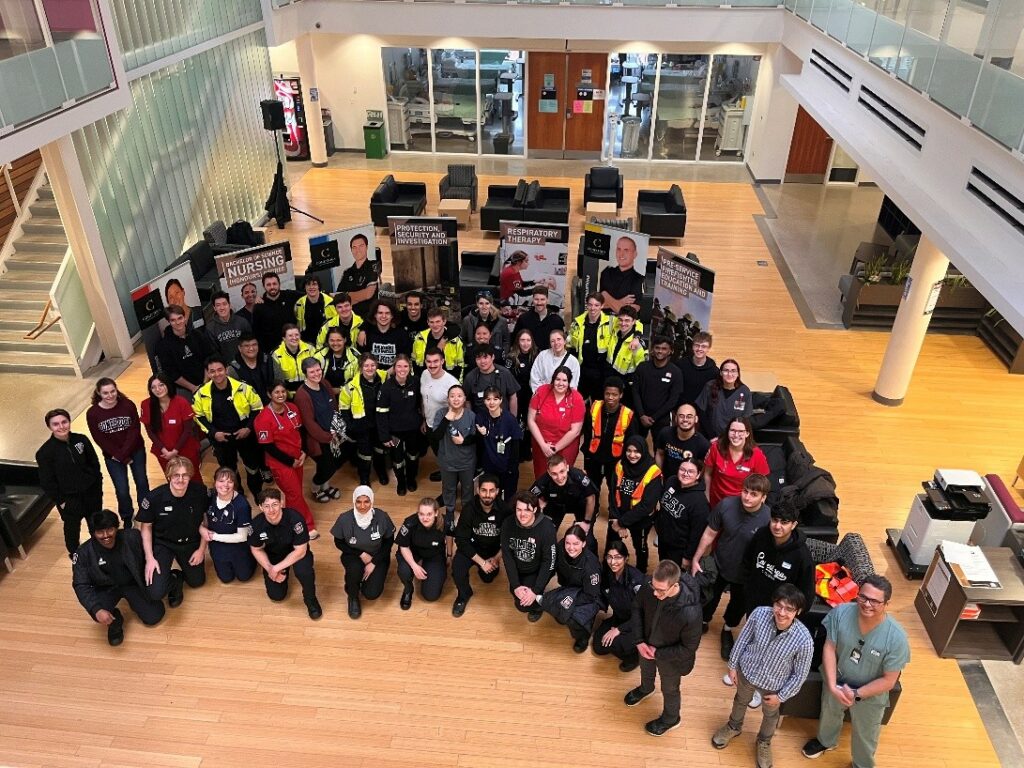
Health & Life Sciences and Community Services students involved in the simulation.
Practicing Industry Skills in a Simulation
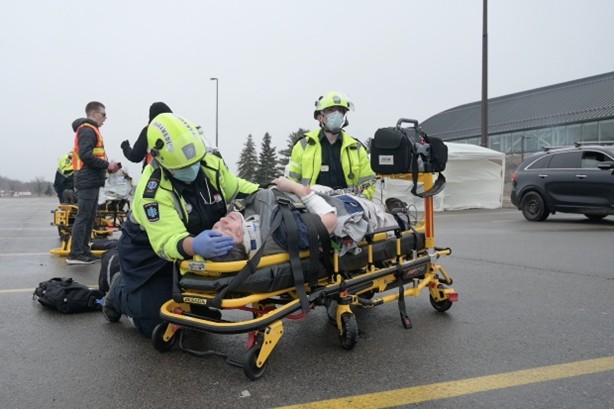
The simulation involved a two-vehicle collision resulting in two people (who were ex-partners) being transported to a hospital. The first vehicle’s passenger went into labour and the second vehicle’s driver experienced chest pains. Police Foundations students reported to their base (acting as real Police Officers) that they needed backup after seeing the severity of the collision and learning of a restraining order between the ex-partners. Protection, Security, and Investigation students were mobilized to secure the scene and to assist with taking statements from witnesses. Afterward, Police and Security communicated details of the situation to Paramedics on the scene who responded to the needs of each patient as required.
“When it comes to the transfer of information between professionals; Paramedics and hospital staff (Physicians, Nurses, Respiratory Therapists etc.) are very used to communicating with one another,” Pam explained. “They follow the SBAR (Situation-Background-Assessment-Recommendation) method to know what requires a clinician’s immediate attention. Transfer of information is very different between community partners (Police, Security, Paramedics). This simulation was designed for students to appreciate the differences in how information is disseminated across various professions.”
Photo #1Photo #2
Photo #1: Interprofessional team of Protection, Security and Investigation; Police Foundations; and Paramedics appear with the person role playing the pregnant and labouring mother. In the simulation’s first phase, the students de-escalated an altercation, controlled a crowd, gathered witness statements, managed patients, and collaborated with each other.
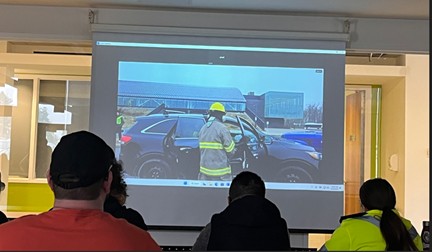
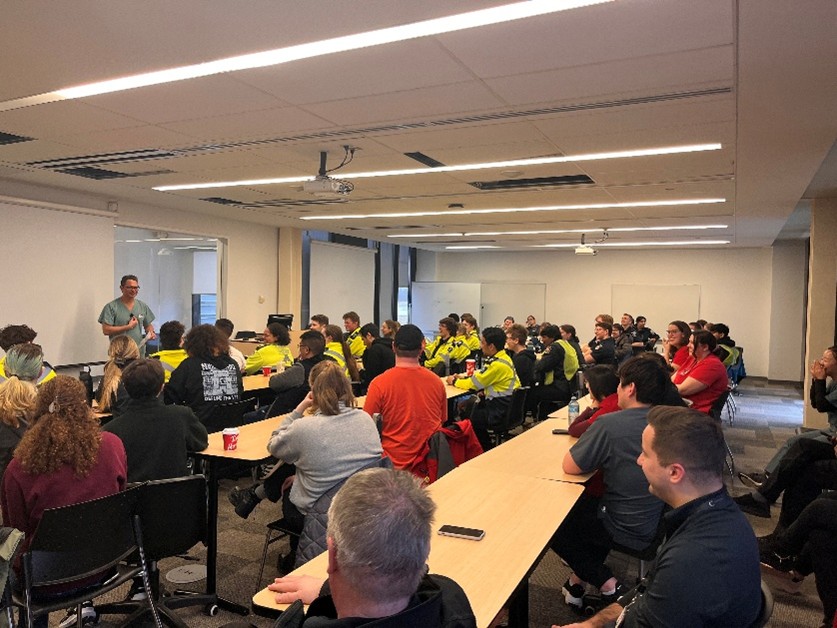
Photo #2: Students watch the simulation’s first phase from a classroom. Conestoga’s Rick Fraser (Manager of Conestoga’s Emergency Management department) narrated the simulation’s events to these students and fielded questions.
Building Cross-Professional Collaboration through Observations and Debriefs
“The simulation’s first phase was the vehicle collision in a Conestoga parking lot,” Pam described. “The students responding to the collision appeared in the lot, and other students assigned to healthcare observed this phase through cameras in a classroom. They took notes on what they witnessed for a debrief later.”
A subject matter expert fielded questions from students observing from the classroom. The expert explained how the Police, Security and Paramedics handled the vehicle collision, to create a frame of reference based on what the healthcare students saw on the cameras.
“In Phase 2, the healthcare students worked with the people affected by the collision. When the one vehicle’s passenger delivered their baby, the simulation ended and all students debriefed on everything that happened,” said Pam. “More subject matter experts reviewed both the simulation’s phases and asked students to recall the communications methods between Security, Police, Paramedics, and hospital staff.”
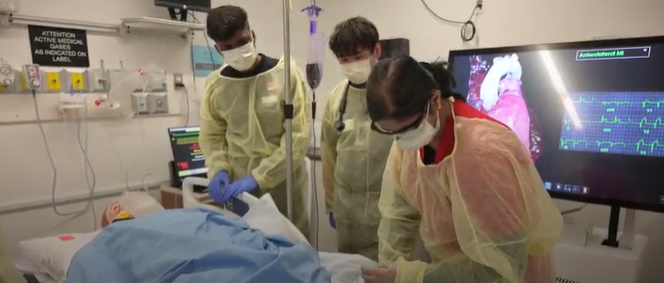
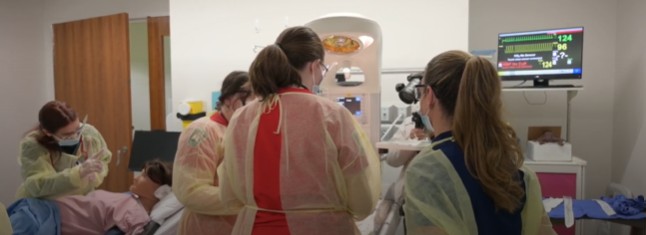
In the simulation’s second phase, emergency room staff manage the patient with chest pain. The live patient was replaced with a high-fidelity mannequin. Karen Singleton led the narrative for the second phase.
In the simulation’s second phase, ER staff manage a patient in labour through to delivery and the resuscitation of a newborn infant.
After both phases of the simulation, Karl Weiss (professor and simulation educator at Conestoga) leads a debrief session with all students involved in it.
Advice to Faculty: Chunking Down Course Content and Designing Peer-Evaluated Learning
“Respiratory Therapy is a three-year advanced diploma with many new concepts and skills for students to learn. “Class content is very heavy, and it is a challenge to deliver this material without overwhelming the students. I find that breaking heavy content into smaller chunks and using real examples of how the topic relates to the practice of Respiratory Therapy helps. I always try to give the students solid reasons as to why they are learning this information.”
In lab settings with a lot of hands-on skills, Pam believes providing students with clear expectations and allowing them to practice communication and hands-on skills repetitively helps them achieve competency at a high level.
“Peer Evaluated Learning involves having students perform practical skills for their peers (classmates) who provide them formative evaluations of these skills at a level consistent with clinical practice standards. Students rotate periodically so that they have opportunities to both perform and evaluate. I encourage students to work with as many different people as possible as everyone moves through their process differently. There is robust learning that occurs through observation and in receiving feedback from multiple sources. Peer Evaluated Learning is an area faculty might consider in their classes,” Pam suggested.
“It has propelled our students forward. When they move into their clinical rotations, they’ve gained strong practical and communication skills which are important aspects of Respiratory Therapy. Our clinical partners are always impressed with the professionalism and clinical practice of the Conestoga Respiratory Therapy students.”
Share this Teaching Tip
Wesley Butler
Wesley Butler, B.PR, B.A. Comm, M.Ed., is Teaching and Learning Coordinator at Conestoga, where he also teaches marketing communications, public relations, and reading/writing skills. He oversees teaching observations and the scheduling of micro-credential courses, including the Post-Secondary Teaching Certificate. Wesley develops internal communication protocols and delivers regular updates and outreach to 3,000 faculty, Chairs, and Deans via digital newsletters, brochures, and flyers. Wesley has launched a feature story series and weekly newsletter to highlight faculty success and share practical teaching strategies, and facilitates E3 workshops on email writing and generative AI.