Backwards Design Made Simple: A Step-by-Step Guide
Published date
Last modified date
Reading Time: 3minutes
As you begin planning your asynchronous course, it’s important to think about what makes an online course effective. Successful courses are accessible, flexible, engaging, and designed with self-directed learners in mind. A crucial first step is defining clear learning outcomes, which will serve as the foundation for your assessments, learning activities, and content creation. Using a structured framework to manage these interconnected elements effectively can help ensure your lessons are consistent, engaging, and aligned with your desired outcomes. In this post, we’ll introduce the backward design process and explain how you can apply it to develop a purposeful, outcome-driven asynchronous course.
What is backward design?
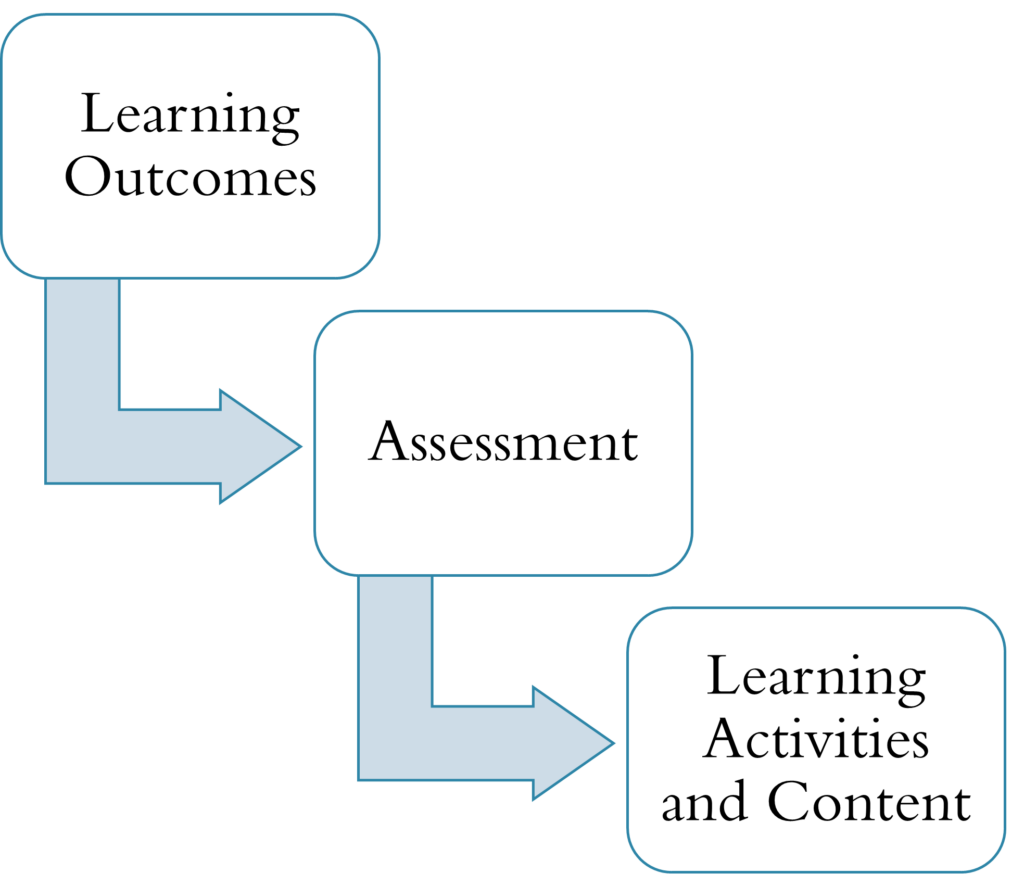
The backward design process simply focuses on planning with the end goals in mind. By starting with the desired outcomes, you ensure the course is purpose-driven, structured, and aligned with the needs of your learners. This design process helps learners understand what to expect, the value of the given learning opportunity and what they will be able to do by the end of the given week (module) (Wiggins & McTighe, 2011). Backwards design can be broken down into three simple steps:
Identify Desired Learning Outcomes
Determine Assessment Evidence
Plan Learning Activities and Content
Figure 1 Backwards Design Workflow
Let us look closer at these three steps!
Step 1: Identify Desired Learning Outcomes
This step forms the foundation of the backward design process, focusing on what learners should achieve by the end of the lesson. At the College, outcomes can be found in the course outline, and you will often select specific unit-level outcomes to guide your weekly lessons, and course-level outcomes will relate to graded assessments. To identify the appropriate outcomes for a lesson, consider the following questions:
What knowledge or skills should learners gain?
What should students be able to demonstrate after completing the weekly lesson?
Answering these questions will help ensure your lesson aligns with the overall course goals and provides a clear purpose for learners.
Tip! Ensure students understand the outcomes they are expected to achieve. Ensure they are specific and clear to the learner.
Step 2: Determine Assessment Evidence
In the second step of this process, you will design and select assessments that will measure whether students have achieved the desired outcomes. Assessments can include graded and ungraded formative and summative assessments.
Tip! Ensure all assessments are feasible in the asynchronous learning environment and include clear instructions that tie them to the related learning outcomes.
Step 3: Plan Learning Activities and Content
The final step in this process involves identifying learning activities that equip learners to achieve the outcomes and prepare for related assessments. These activities and content should be flexible, self-paced, and engaging, incorporating active learning and reflection opportunities. Additionally, consider integrating technology and tools that enhance content delivery, foster interaction, and promote learner engagement.
Tip! Design manageable lessons for your learners by chunking the content and scaffolding the learning over the weekly module.
Utilizing Co-Pilot in Course Design
Generative AI tools, such as Microsoft Co-Pilot, can be helpful in course design, particularly when applying the backward design framework. Explore by applying the following steps:
Step 1: Open your course outline related to your online course development. Step 2: Select one (or more) unit outcome to explore in relation to backward design. Step 3: Open Microsoft Co-Pilot and use the following prompt to get you started, and replace the items in brackets with your own course information.
Prompt: You’re teaching a course on {topic} at a college in Ontario, Canada. The learners are {learner demographics}. Use the backward design model to draft a 2-hour lesson plan that addresses the {course unit outcome(s)}. The mode of delivery is {mode}.
Implementing backward design in your asynchronous course development ensures strong alignment between learning outcomes, assessments, and activities. This approach creates a clear and structured learning approach, making it easier for self-directed learners to navigate your course. Additionally, it highlights the relevance of the material, helping students see the purpose behind their learning and increasing their motivation to engage.
References
Wiggins, G. P., & McTighe, J. (2011). The understanding by design guide to creating high-quality units. ASCD.
Share this Teaching Tip
Marcie Chaudet
Marcia Chaudet, Ph.D. (Biological Sciences), has worked in post-secondary education since 2010, supporting faculty and support staff with their teaching development. For the past ten years, Marcia has taught in the biological sciences in both university and college sectors. Marcia specializes in approaches that support students learning in hybrid and online learning environments and empower faculty to take risks in their online teaching.