When designing your asynchronous course using backward design, start by clearly defining the learning outcomes students should achieve each week. Then, determine the most appropriate assessments to evaluate their progress. Your ultimate goal is to ensure students can effectively demonstrate their learning and meet the intended outcomes. In an asynchronous environment, assessments must be thoughtfully designed to accommodate self-directed learners, considering both their needs and the unique dynamics of online learning. This post will introduce considerations of designing and translating existing assessments into your asynchronous course development.
Types of Assessments
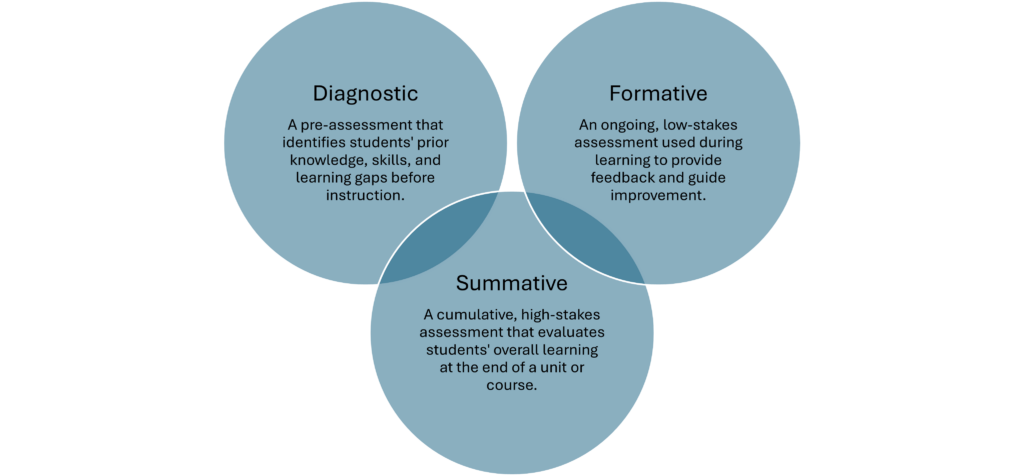
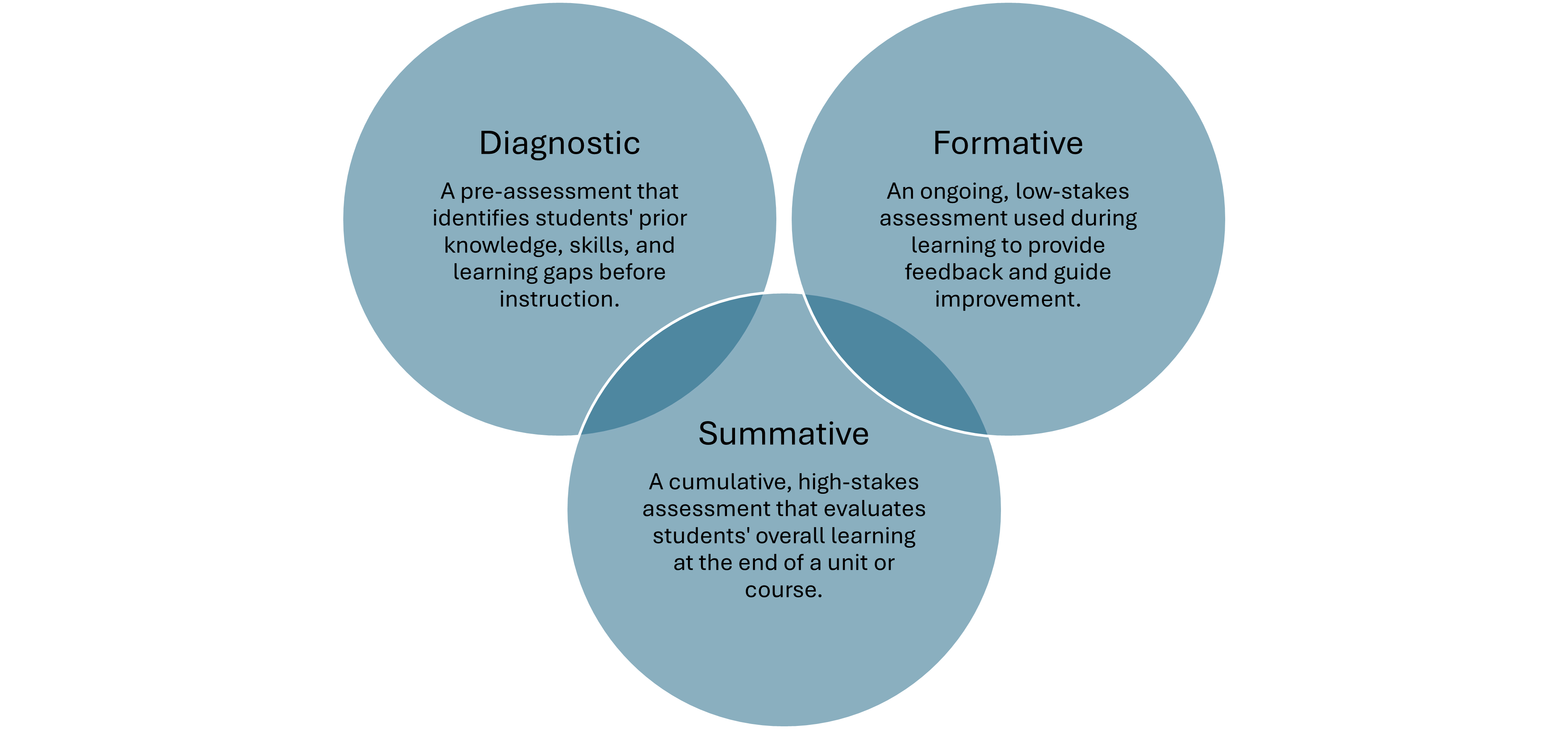
Before designing assessments, let’s review the three key types: diagnostic, formative, and summative. Understanding these categories will help us determine how they fit within an asynchronous learning environment.
Types of Assessments
With these assessments in mind, let’s explore some examples to inspire our course development!
Diagnostic Assessments
Pre-quiz – A short quiz that tests their knowledge of concepts before they are introduced.
Self-assessment – A reflective exercise where students evaluate their skills and understanding at the beginning of a lesson.
Formative Assessments – Ungraded
Note – these formative assessments provide opportunities for practice and feedback without impacting grades.
Self-Check Quizzes– Short auto-graded quizzes with immediate feedback to support students in assessing their comprehension.
Self-Reflections – Learners respond to a reflection question about the lesson content in a private reflection box. Feedback can be provided by the professor during instruction.
Concept Mapping – Students create visual representations (e.g., mind maps) of key concepts using digital tools (Example – Mirual), which they can later use as a study aid.
Formative Assessments – Graded
Short quizzes – Periodic quizzes (e.g., every few weeks) that check understanding and provide timely feedback.
Practice Assignments – Small applied tasks that are graded with instructor feedback, ensuring students receive guidance before progressing to new material in the next weekly module.
Discussion Post – Students engage in online discussions by responding to a prompt and interacting with peers. Feedback can be provided by the professor during instruction.
Summative Assessments
Final Exam – A comprehensive test that covers several weekly modules and topics (for example – Weeks 9-14).
Final Project – A collaborative group assignment where students work asynchronously to complete a complex task.
Case Study Presentation – Students analyze a real-world scenario and submit their findings through a written report or video presentation.
Tips for Effective Asynchronous Assessment Design
Adapt existing synchronous assessments for the asynchronous environment—you don’t have to start from scratch!
Incorporate a variety of formative (both graded and ungraded) and summative assessments to keep students engaged and motivated.
Offer flexibility in assessments by allowing multiple formats for demonstrating learning, such as video or written submissions.
Provide clear, well-structured instructions to support self-directed learners. Use detailed rubrics and examples of work to clarify expectations.
Using Microsoft Copilot for Asynchronous Assessment Design
Utilizing Generative AI tools can help support the design of assessments for your asynchronous course. Explore the use of Microsoft Copilot for assessment development by applying the following steps:
Step 1: Open your course outline related to your online course development.
Step 2: Identify a course-level outcome that you would like to explore developing an assessment for. This could be an outcome that typically is challenging to target, or you are struggling with its assessment in your asynchronous course.
Step 3: Open Microsoft Co-Pilot and use the following prompts in order:
Prompt 1: You are a faculty member teaching {insert course topic} in an Ontario University at the level of {insert level}. The outcome for an asynchronous online course is {insert course outcome}. Please analyze the course topic, outcome, and any additional information carefully, then provide examples for diagnostic, formative and summative assessments. Provide and APA 7 reference for the outputs.
Prompt 2: Please provide suggestions for feedback for the given suggested assessments {insert identifier based on Copilot output}.
Prompt 3: Please provide suggestions for consideration for self-directed learning for this assessment in an asynchronous course.
As you begin designing your asynchronous assessments, a few things to keep in mind – ensure your assessments align with your learning outcomes, support self-directed learners, and adhere to the College’s Evaluation of Student Learning Policy.
Share this Teaching Tip
Marcie Chaudet
Marcia Chaudet, Ph.D. (Biological Sciences), has worked in post-secondary education since 2010, supporting faculty and support staff with their teaching development. For the past ten years, Marcia has taught in the biological sciences in both university and college sectors. Marcia specializes in approaches that support students learning in hybrid and online learning environments and empower faculty to take risks in their online teaching.